Trend trading is a fundamental approach in financial markets based on systematically following the prevailing price direction. Instead of attempting to predict turning points, this method assumes that prices tend to continue in the same direction once a trend is established.
Historical evidence demonstrates that the majority of substantial profits are generated during periods of strong directional movements. As a result, trend-following strategies are widely adopted not only by retail traders but also by institutional investors, asset managers, and Commodity Trading Advisors (CTAs).
The Logic Behind Trends
Price trends emerge from collective market behavior. Macroeconomic data, monetary policy changes, or geopolitical events can create persistent imbalances between supply and demand.
When an asset begins to rise, new buyers reinforce the movement, triggering a self-reinforcing upward trend. Conversely, widespread selling accelerates declines, driving downward trends. The essence of trend trading is to align with these dynamics rather than resist them.
Historical Case Studies
Richard Donchian
Richard Donchian is often referred to as the father of modern trend following. In the 1950s, he developed a systematic strategy using moving averages. His rule was straightforward: buy when the price trades above the 50-day moving average and sell when it moves below. Despite its simplicity, this method proved highly effective and remains the foundation of many contemporary models.
The Turtle Traders
In 1983, Richard Dennis and William Eckhardt conducted a famous experiment. They trained a group of individuals with no prior trading experience in the basics of trend-following. Using breakout systems and strict risk management, these “Turtles” generated millions in profits. The experiment proved that success in trend trading does not depend on intuition but on discipline and adherence to predefined rules.
John W. Henry
John Henry, founder of JWH & Co., built his fortune by applying systematic trend-following to futures markets. His fund achieved consistent returns, and he later became well known outside finance as the owner of major sports teams. His career illustrates how trend following can serve as the basis for long-term professional success.
CTA Funds
Commodity Trading Advisors (CTAs) have used trend-following strategies for decades. A striking example occurred in 2008: while global equity markets collapsed, CTAs recorded record profits by capturing sustained downtrends in currencies and commodities.
Practical Application
Identifying a Trend
- Uptrend: A sequence of higher highs and higher lows.
- Downtrend: A sequence of lower highs and lower lows.
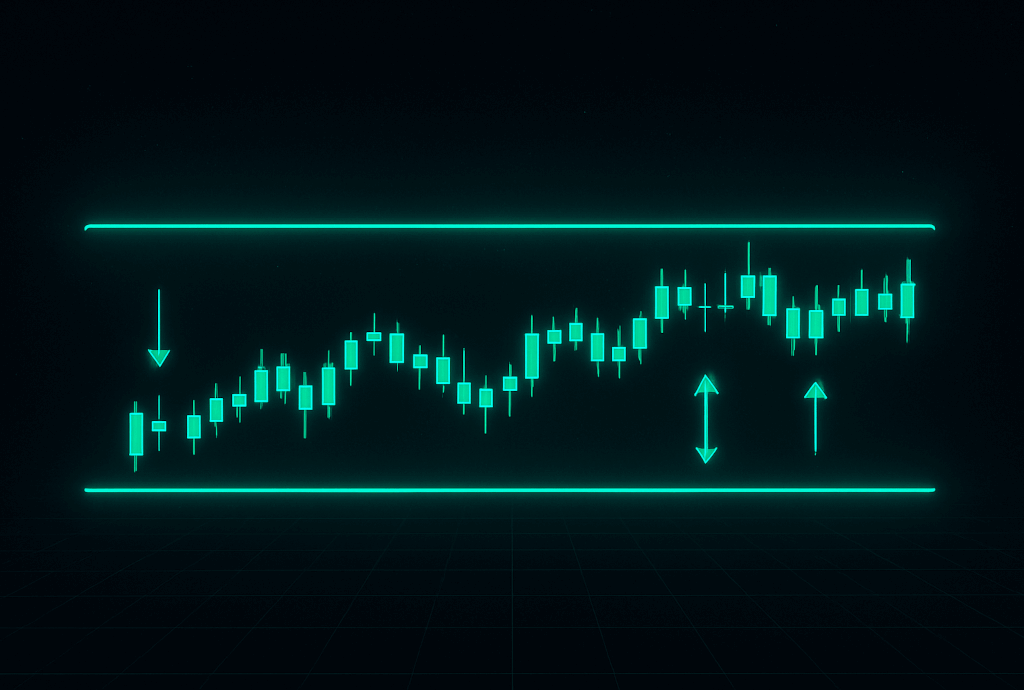
- Sideways market: Price moves within a horizontal range without a clear direction.
Key Technical Tools
- Moving Averages (SMA, EMA): Smooth out price data to reveal long-term direction.
- MACD: Highlights momentum changes through the interaction of short- and long-term averages.
- ADX: Measures the strength of a trend. Values below 20 indicate weak trends, while values above 25 confirm stronger trends.
- Price Action: Analysis of support, resistance, and candlestick formations without reliance on indicators.
Market Example
Between 2014 and 2015, EUR/USD experienced a prolonged downtrend, falling more than 3,000 pips over 12 months. A trader using a moving average crossover system (50-day vs. 200-day) would have consistently received sell signals and captured a significant portion of the decline.
Advantages and Limitations
Advantages:
- High profit potential during strong market moves.
- Universally applicable across asset classes.
- Can be systematically coded and automated.
Limitations:
- Poor performance during consolidations or sideways markets.
- Frequent false breakouts in low-volatility environments.
- Requires strict discipline in execution.
Algorithmic Trend Trading
Algorithmic implementation of trend-following strategies has become one of the most common practices in modern trading. Automation eliminates human biases such as fear, greed, or premature exits.
A typical algorithmic model might operate as follows:
- Identify trend direction using a 50/200 EMA crossover.
- Confirm trend strength with ADX.
- Enter on breakout confirmation.
- Manage the trade with trailing stops or predefined exit levels.
The main advantage of automation lies in its objectivity and consistency. Algorithms can monitor markets continuously, react instantly to signals, and execute trades without hesitation.
Best Markets for Trend Strategies
Trend-following works best in liquid markets with clear directional moves:
- Forex: Major pairs such as EUR/USD, GBP/USD, and USD/JPY, often driven by macroeconomic shifts.
- Commodities: Gold and crude oil, where supply-demand imbalances and geopolitical risks generate strong moves.
- Equity Indices: S&P 500 and Nasdaq, known for long-term cycles of growth and sharp downturns.
- Cryptocurrencies: Bitcoin and Ethereum, historically characterized by pronounced bull and bear phases.
Practical Recommendations
- Focus on higher timeframes (H4, D1) to filter out market noise.
- Use indicator combinations (e.g., MA + ADX, MACD + Price Action) for confirmation.
- Apply strict risk management: set stop-losses and size positions carefully.
- Avoid guessing market tops or bottoms; follow the established direction.
- Let profits run by using dynamic exit strategies such as trailing stops.
Conclusion
Trend trading remains one of the most reliable and time-tested approaches in global markets. Its relevance has persisted for over half a century, and it continues to deliver consistent results when applied systematically.
The success stories of Richard Donchian, the Turtle Traders, John Henry, and CTA funds demonstrate that discipline and adherence to rules are the cornerstones of profitability in trend following.
Algorithmic execution enhances these strategies by removing human emotions, ensuring precision, and maintaining continuous market monitoring. Liquidity and strong directional moves make major currency pairs, commodities, indices, and leading cryptocurrencies particularly well suited for this approach.
In essence, trend trading is not merely a strategy but a comprehensive philosophy of market participation. It encourages traders to move with the market rather than against it, harnessing the power of momentum to achieve long-term success.
Next trading strategy
Range Trading
Trade price swings between support and resistance when the market is moving sideways.