Grid trading is a systematic strategy that places buy and sell orders at predefined intervals above and below the current market price. The result is a “grid” of orders designed to capture profits as the market fluctuates. Unlike trend-following or breakout methods, grid trading does not require forecasting the direction of price movement. Instead, it takes advantage of volatility and range-bound behavior by executing trades in both directions.
Grid trading has become popular among retail traders because of its simplicity, scalability, and suitability for automation. It is particularly well known in forex markets, but it is also applied in commodities, indices, and cryptocurrencies.
The Logic of Grid Trading
The core idea is to profit from price oscillations. A trader defines a price interval, say, every 50 pips and sets buy orders below the market and sell orders above. When price moves up and down, the system closes trades once they reach a target profit, while new orders are placed to maintain the grid structure.
For example, if EUR/USD is trading at 1.1000, a trader might set buy orders at 1.0950, 1.0900, and 1.0850, while placing sell orders at 1.1050, 1.1100, and 1.1150. As the market oscillates, each completed cycle generates incremental profits.
This structure allows traders to benefit from both ranging and moderately trending markets, provided volatility is sufficient to trigger multiple levels of the grid.
Historical and Practical Examples
Grid strategies have been used by professional traders and hedge funds, particularly in periods of stable exchange rate environments. In the early 2000s, when EUR/USD and GBP/USD often traded in broad ranges, grid traders exploited these cycles to generate steady income.
In cryptocurrencies, grid trading became highly popular during sideways phases of Bitcoin and Ethereum between 2018 and 2020. Many exchanges even introduced built-in grid trading bots for retail clients, allowing them to automate the strategy without programming knowledge.
Technical Implementation
Key parameters in a grid system include:
- Grid size: the spacing between buy and sell orders.
- Lot sizing: whether each level has the same volume or uses geometric progression.
- Take-profit and stop-loss: profit per order and risk management boundaries.
- Directional bias: some grids are symmetrical, while others operate only long or only short.
A common variation is the “martingale grid,” where position size increases after losses, and the “anti-martingale grid,” where size increases after wins. More conservative models use fixed lot sizes and defined equity stops.
Advantages and Limitations
Advantages:
- No need to predict direction, profits can be generated in both rising and falling markets.
- Well suited for automation.
- Flexible and adaptable to many asset classes.
Limitations:
- Exposure can accumulate quickly in strong trending markets, leading to large drawdowns.
- Requires careful risk management, including equity stops or daily loss limits.
- Best applied in ranging conditions with moderate volatility.
Algorithmic Grid Trading
Grid systems are among the most common in algorithmic trading because their logic is easy to code. A trading robot can automatically place orders at intervals, manage exits, and adjust the grid dynamically based on volatility measures such as Average True Range.
For example, an algorithm can:
- Define spacing based on recent volatility rather than fixed pip levels.
- Reduce position size when equity drawdown exceeds a threshold.
- Dynamically pause the grid in periods of extreme directional trends.
Automation is essential, as manual execution of dozens of orders is impractical. Many brokers and exchanges now provide built-in grid bots, though professional traders often prefer custom-coded systems to integrate advanced risk controls.
Best Markets for Grid Trading
Grid trading is most effective in markets with recurring volatility and frequent oscillations:
- Forex majors such as EUR/USD, GBP/USD, and USD/CHF.
- Gold and silver during extended consolidations.
- Index futures like the DAX or S&P 500 when trading ranges dominate.
- Cryptocurrencies, particularly Bitcoin and Ethereum, which often alternate between trending and sideways phases.
Practical Recommendations
- Start with conservative grid sizes and fixed lot volumes to control exposure.
- Avoid using martingale multipliers without strict capital management.
- Combine grid trading with volatility filters to avoid entering just before breakouts.
- Use algorithmic implementation to maintain discipline and consistency.
- Always define maximum drawdown thresholds to protect capital.
Conclusion
Grid trading remains one of the most recognizable systematic strategies in retail and algorithmic trading. Its appeal lies in the ability to profit without predicting direction, turning volatility into opportunity. Historical use in forex, growing popularity in cryptocurrencies, and the widespread availability of automated bots confirm its relevance.
At the same time, grid systems require disciplined risk management. Without safeguards, they can accumulate large exposures during strong directional moves. When properly implemented with automation, equity controls, and volatility-based adjustments, grid trading can serve as a robust tool within a diversified trading portfolio.
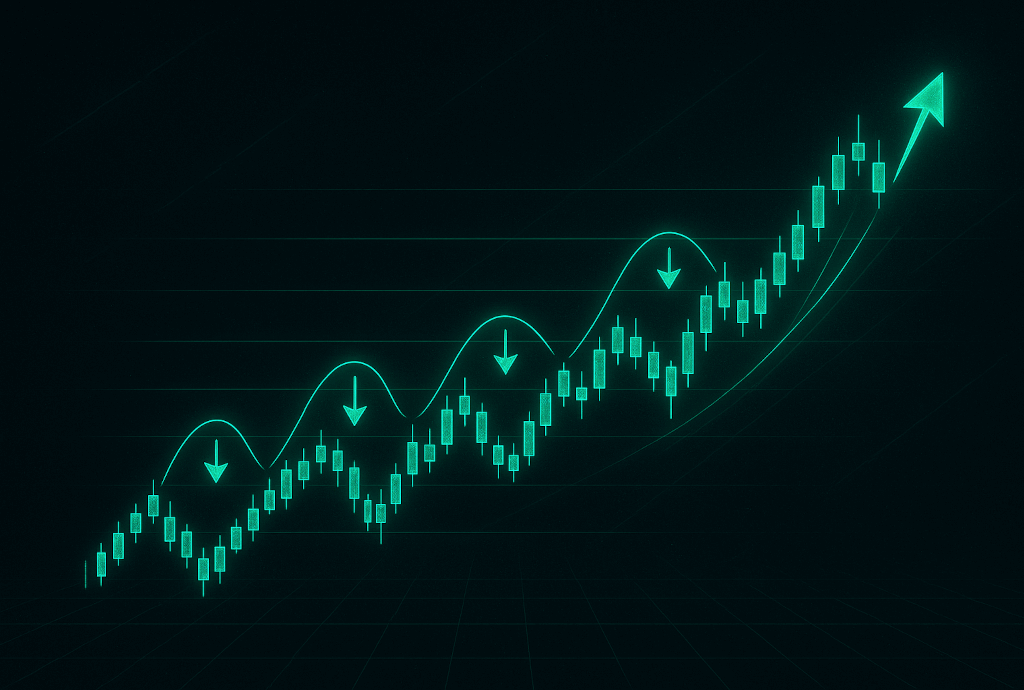
Next trading strategy
Swing Trading Strategy
Hold positions for days to weeks to capture larger moves within a broader market cycle.